ECAT is hard to game — and that's a good thing
CMS's new ECAT measure folds rooming delays, walkouts, boarding, and long stays into one score. The easiest way to improve performance will be to actually improve flow.
If you run an emergency department, you need to understand ECAT, because your flow problems are about to become much more visible.
The Emergency Care Access & Timeliness measure is CMS’s new attempt to measure flow through the emergency department. It reports the percentage of patients who are exposed to “bad flow.” Reporting is voluntary in 2027 and mandatory in 2028, and ECAT replaces two measures we’ve reported for years: median length of stay for discharged patients and left without being seen. There’s money on the line, too: hospitals that miss outpatient quality reporting requirements risk a 2-percentage-point cut to their annual outpatient payment update.
In other words, ED flow is about to be on display — to leadership, to competitors, and (most importantly) to patients.
As with any measure, it’s worth asking, “Does this actually measure the thing we care about?”
I think it does. Mostly.
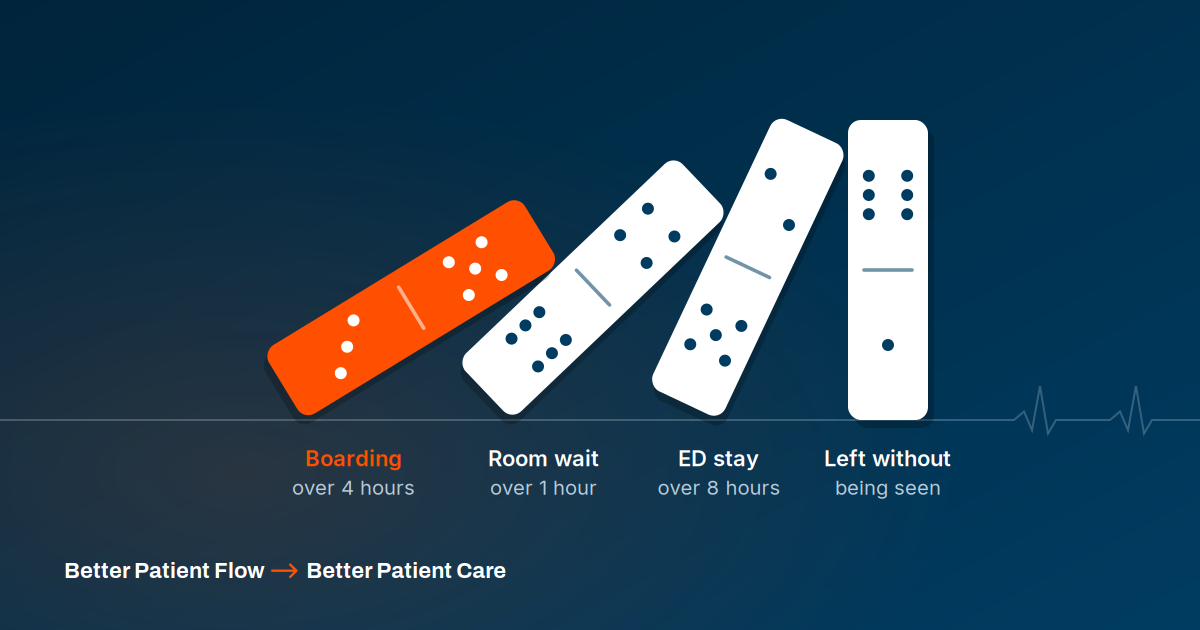
For years we’ve measured flow in pieces: door-to-doc, length of stay, boarding, and left without being seen (to name a few). Each tells you something, but somebody still has to stitch them together and decide what they say about the department. ECAT combines many of the individual components of flow through an emergency department visit into one score. A visit counts against you if the patient waited more than an hour for a treatment room, left without being evaluated, boarded more than four hours after admission, or spent more than eight hours total in the ED. The denominator is all ED visits, so ECAT essentially measures the percentage of your patients who experienced poor flow.
That matters, because we’ve gotten very good at making individual metrics look better. That’s going to be a lot harder with ECAT.
Take provider in triage as an example. When CMS started reporting LWBS rates, savvy EDs put a provider in triage and made door-to-doc look great. Some patients who would have walked out now leave “seen,” so LWBS improves too. However, we didn’t create a bed and we certainly didn’t create downstream capacity. If anything, we may have throttled downstream capacity even more by pulling provider coverage away from the main department. We changed the process to artificially decrease the measured failure without necessarily improving flow, which is what the measure was meant to capture. As a caveat, I am a huge fan of provider in triage for reasons outside the scope of this article — just not as a numbers-gaming strategy.
With ECAT, a provider evaluation in triage might keep a patient out of the LWBS bucket, but it won’t fix delays in rooming, boarding, or long ED stays.
ECAT wraps around the entire problem with flow in the ED. If you think about an ED visit — and likely any work system — there are basically three phases: 1) the time it takes to start work once the work has been accepted (time to room), 2) the time it takes to complete the work once started (best approximated by ED LOS), and 3) the amount of time it takes to get work out of the system so it’s not occupying resources and blocking flow (boarding). ECAT adds a fourth sign of poor flow that is a good barometer of any system: lost work (LWBS).
Can’t get patients into rooms? Allow me to introduce you to ECAT. Patients spending more than eight hours in the ED? It shows up in your score. Admitted patients who can’t leave because the hospital has nowhere to put them? You can add that patient to your numerator. As an aside, one of the additional benefits of ECAT is that it may force boarding to be recognized as what it has always been: a hospital system problem, not just an ED problem.
One of the things that makes ECAT uniquely difficult to game is that these flow problems are interconnected; they have a domino effect on each other. Boarders occupy ED beds, new patients can’t get into them, the waiting room grows, and eventually people leave. Slow internal processes do the same thing from the middle. One flow problem can cascade into several failure points in a single patient’s visit. If you game one number, the broken flow still shows up somewhere else in your ECAT score.
You can move a flow problem around. ECAT makes it much harder to make it disappear.
ECAT is going to make some leaders uncomfortable. Most medical directors already know whether they have a boarding problem, a length-of-stay problem, a waiting-room problem, or an LWBS problem. Those numbers get discussed in ops meetings. But almost nobody outside the department is assembling them into a consolidated picture of how well patients actually move through the ED. A publicly reported measure changes that: everyone will be able to see it.
As somebody who believes that the solution to much of our suffering in healthcare is better patient flow, I think ECAT is a good thing. Patients don’t experience flow as a metric. In the best-case scenario, they experience bad flow as a prolonged period of pain, nausea, or uncertainty, or as spending most of a day in an exposed ED hallway. In a slightly worse scenario, they experience all the same pain, nausea, and uncertainty accompanied by the hopelessness of feeling blocked from emergency care when they leave without being seen. In the worst-case scenario, the one every ER doctor I know worries about, patients die or suffer permanent harm that could have been avoided if not for bad flow.
ECAT isn’t perfect, and there are certainly some ways that different departments might produce different numbers despite similar flow. It doesn’t account for acuity, differences in how hospitals interpret definitions and capture data will matter, and at its core, every metric creates incentives. However, it passes the test I care about most: It will be hard to improve your ECAT score without actually improving flow.
Standard disclaimer: I don’t represent CMS, this is my read of the measure as it stands today, and details may change. Views are my own.